Tuesday, 26 March 2013

Propagation Table How To...

So the as spring has sprung, we've started planting our seeds, but to get a head start on germination we built a propagation table.  We used heat cables to supply the bottom heat to increase soil temperature in the soil flats; this improves speeds up germination rates.


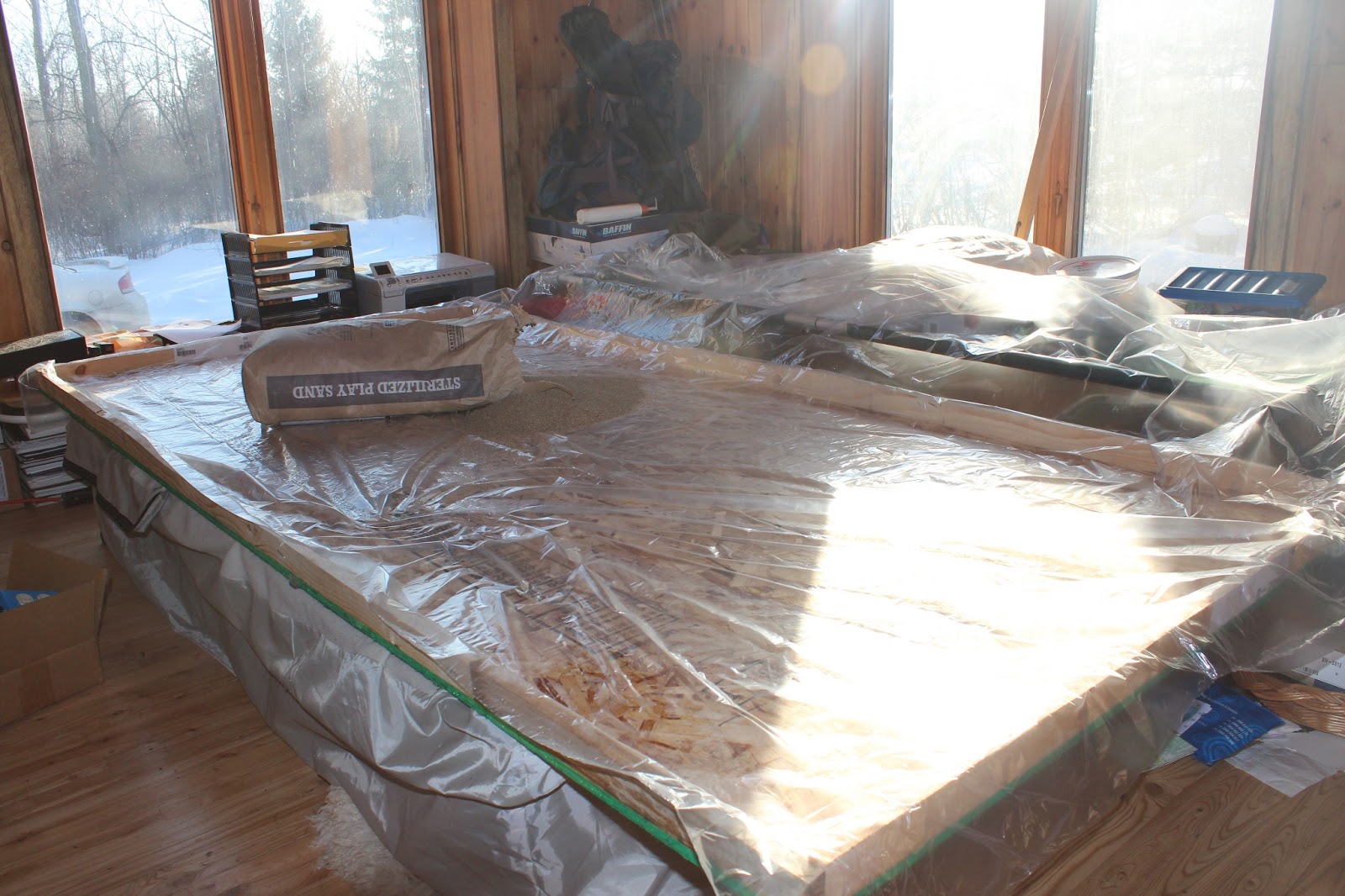
We started with a piece of OSB plywood, and screwed some 1"x2"s (ripped 1x4s) for edges and placed plastic on the bottom to hold the sand. We got some playsand disperse the heat more evenly.  It took 3 25kg bags of sand for the whole project.


We poured 1 bag for a bottom layer.  We just used a dust pan to spread the sand, maybe a trowel or something might work better, but anything can be used.


Thermostatically controlled heat cable, adjustable at 40-100*F for varying germination temps.

 Once the heat cable was spread out in an even pattern to disperse the heat throughout the entire table, we covered it with a layer of sand.  We watered the sand to increase the heat dispersion and to increase moisture inside the system, like water vapour in a greenhouse.


The table fits 16 10"x20" seed trays.  We're starting onions, leeks, and rosemary with the first batch of starts.  Next up will be parsley, rhubarb, and celery.
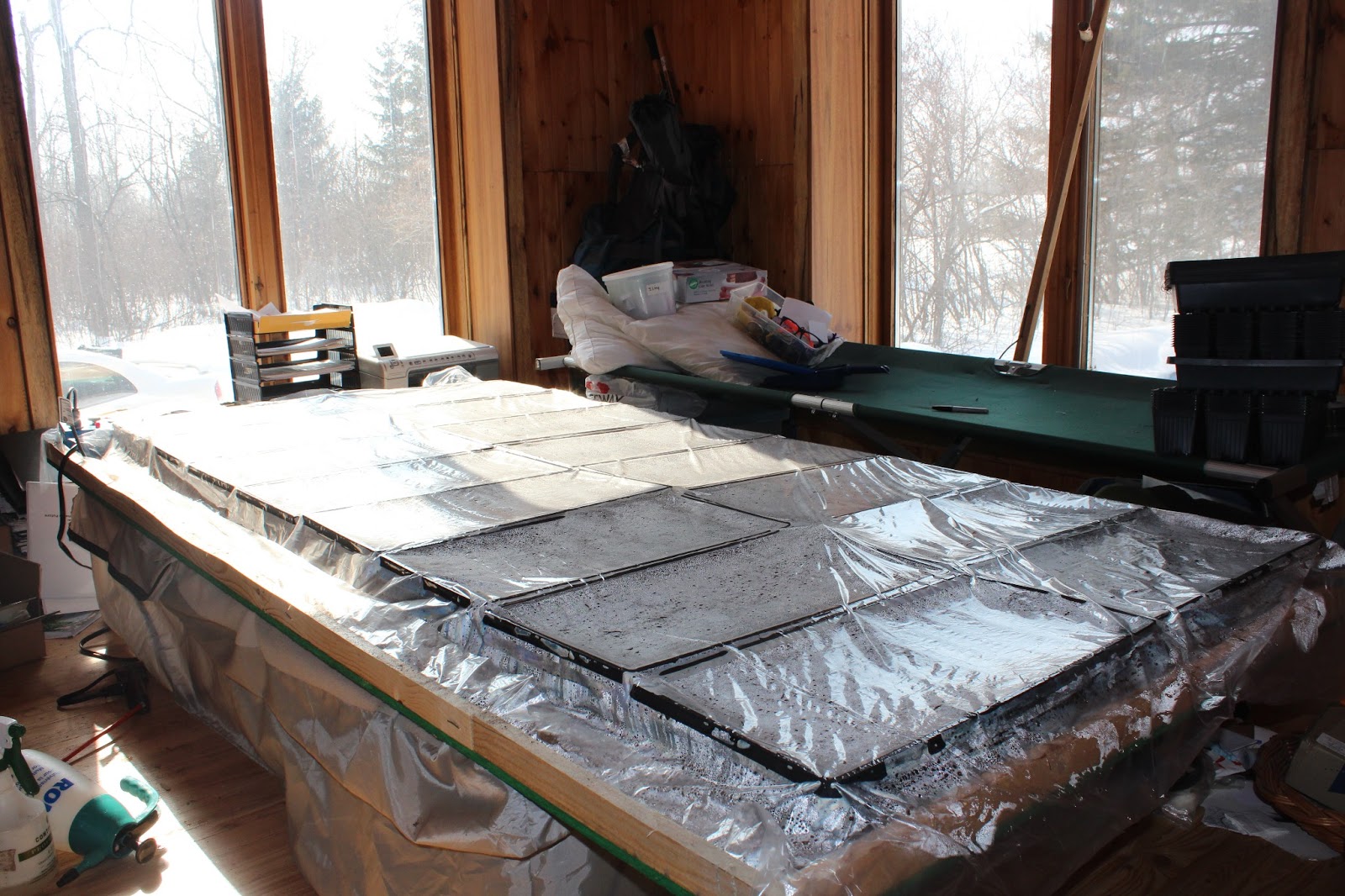
After a day of heating up the water has condensed on the plastic and drips back on to the flats, this is keeping the soil moist and decreases the need to water the seedling, also decreasing disease and pathogens, though the seedlings can't stay in too moist of an environment once they have emerged.

That's our propagation table, once the greenhouse is up, we'll be making 3 more so we can accommodate all our seed starting flats, we;ll need lots more room once the snow FINALLY melts!

Here's a link to find the thermostat and heat cable:
http://www.growers-inc.com/propagation-heat-cables.html
It was the cheapest place I could find the heat cable and thermostat, its in the states, but shipping and customs fees were reasonable.

I'm listening to rap right now and its got me amped up and wanted to sign-off with some cool phrase, but sadly I'm a white male farmer...I'll try next time, night all!

Monday, 25 February 2013

Food e. Farm Feature

Paper.li

So maybe you have noticed, whoever "you" might be, who am I kidding there are no real followers of the blog yet, so no "you" haven't noticed the new gadget next to the posts, but for any of you wondering its one of those hipster twitter paper.li things.  You know the website that lets you make your own newpaper looking bloglike pages.  So I decided it would be a great way to help get out all the ideas bouncing around in our heads, and all the exciting events happening in the agricultural and food industries.

The paper highlights issues around organic and sustainable agriculture and farming practices, along with homesteading ideas and stories around peak oil, renewable energy, the dangers of GMOs and pesticides, as well as trending issues on twitter on all these topics.  There are photos, links, and videos supporting all the stories and help get you to where the information is.

Here's the link Food e. Farm Feature , check it out, share it, subscribe it, show it to your friends, there's lots of good info flowing so check it often!

Oh by the way, we're getting lots of our seed orders in, and I will be starting the seed propagation table tomorrow hopefully, the next project (after some seeds are started) will be the solar collector to heat the greenhouse!  I'll post some picks of the progress!

Cheers,
Cubro

Thursday, 31 January 2013

What does a Farmer do in January?

On this chilly January night (< -30*c), you may think to yourself, its so cold, a farmer can't possibly be doing much but cozying up in a comfy chair next to a fire with a warm cup of tea.

Well to tell you the truth, that's exactly what I'm doing, but at the same time, I'm researching on the computer many different things, from trends in the food industry, political and social issues in agriculture and general current events that might affect  us on the farm.  A few other themes I am focusing on right now are vegetable zero-minimum tillage practices, and a particular project of late has been planning out the field plan and planting space required for harvest yields to meet our CSA and market customers' needs.

Some of the global, national, and local current events that I think people should be concerned with (I'll post some links for each issue), I'll try and limit my concerns to food and agriculture issues (try):
I will be placing our first seed order of the year in the next couple of days, focusing on our early starts, like onions, leeks, rosemary, parsley, and brassicas.  I am also looking at ordering asparagus crowns so that we can provide at least some asparagus for the market this year, more for next and even more after about 2 years!

These are all things I generally do in the morning over a cup of tea and some breakfast, or in the evening under the lamp, during the day I have been mixing feed (today was overly joyful with the windchill warning), collecting wood to heat the house, cleaning up around the yard to get ready for the move up to Adam and Dacia's.  Helping Adam with chicken chores when we're up there, pooring feed, filling water, collecting eggs, spreading bedding, and mucking out the barn every few weeks; not to mention hovering over the chicks to make sure they're doing alright!  Soon added to that list will be starting plants in the window, and then moved into the greenhouse closer to March.

As of late chasing cute little never-before-seen (by me or Ashley) has taken up some time.  First we had a Northern flying squirrel come down the stove pipe and into the wood stove (luckily for it, the fire had gone out) and then chasing it around is glided around the kitchen!  And now in the last two days we've been chasing a little ermine around the pantry as it tries to take our eggs down a sewer pipe hole!

Anyhow it will be February soon and the title won't do, so now I have to get my curling stuff ready to go curling on the weekend!

Friday, 25 January 2013

QuinWHAT...Quinoa

WE'RE GROING QUINOA!!!

There's been a lot of talk about Quinoa over the last few years (even though its an ancient grain first grown around the same time as the origins of corn and potatoes) describing its monumental health effects, to more recently about whether this boom in demand and commodification is helping or harming the local food system and the people that rely on it in the Andean countries, mainly Peru, Ecuador, and Bolivia.

The common sense thought would be that this region is selling a product that is now increasing in price, therefore the region should be better off.  The problem with that thinking, is that not all the population are farmers, particularly independent family owned operations, creating a problem in two different ways.  1, the ultra poor non farmers can't grow or now afford what used to be a cheap local crop, that is one of the most nutritious crops in the world. 2, now that quinoa is a commodity, it attracts corporations, driven only by profits, will start buying up land and growing vast amounts of the crop, making it harder for smaller farmers to compete.  Out of region owned corporations' profit doesn't necessarily stay in the local economy and pays farm workers too little to afford the food they are helping to grow.

Regardless, I haven't been to this region in the world, and don't know how this economic issue is affected it; as I'm sure most if not all these reporters, and so called economic experts most likely haven't either, so I'm not going to say whether or not the food security of the region is increasing or decreasing.

What I do know is that there are many health benefits to this plant, and many advantages to growing this plant as a food crop.

Health benefits:

  • It has a high content of protein at 14%
    • But more importantly its a source of complete protein-containing all 9 amino acids
  • It is gluten free, so it makes for a good wheat flour and rice substitute
  • It is a good source of dietary fibre, phosphorus, magnesium, iron, and calcium
    • helping to detox your body, aid digestion, and fighting breast cancer, and diabetes

Agronomic advantages to farmers include:

  • It is a very hardy plant, able to withstand high day time temps and below freezing night time temps
  • It requires very little maintenance due to it tall growth form out-competing many weeds
  • It needs consistent moisture early in development a dry conditions during seed development (that sounds like Manitoba)
  • It has huge yield potential due to a large amounts of seed produced
  • It requires low amount of nutrients!
We hope to offer this ancient super food later in the summer as it takes about 100 days to mature and produce a harvest, look for it in later August at our farmers market stall in Osbourne, River Heights, and Arnes!

Read for yourself:


Background on Quinoa

http://en.wikipedia.org/wiki/Quinoa
http://nutritiondata.self.com/facts/cereal-grains-and-pasta/10352/2

Recipes

Is the Quinoa Boom hurting Andean Food Security?

http://goo.gl/mYFsz
http://www.cbc.ca/news/business/story/2013/01/17/business-quinoa-prices.html
http://www.globalnews.ca/reality+check/6442793720/story.html
http://www.guardian.co.uk/commentisfree/2013/jan/16/vegans-stomach-unpalatable-truth-quinoa
http://squinch.net/2013/01/18/can-i-have-my-quinoa-and-the-andean-farmer-eat-it-too/

Is the Quinoa Boom helping Andean Farmers?

http://goo.gl/TXiav
http://www.guardian.co.uk/commentisfree/2013/jan/22/quinoa-bolivian-farmers-meat-eaters-hunger
http://bbs.chinadaily.com.cn/thread-821947-1-1.html

Monday, 21 January 2013

The Problems with TOO MUCH

The trick to feeding the world into the future will not be to PRODUCE more food, but to actually produce the same (it could even be less) and DISTRIBUTE the food further and to more people!  There was a good talk on Ideas on CBC Radio, titled Feeding 10 Billion, by Raj Patel.  Here it is:

CBC Ideas in the Afternoon: Feeding 10 Billion-Raj Patel

A revision on the history of the Green Revolution, which was actually an unRed Revolution, meant to combat Communism around the world, with American (gov't and corporate) backed coupes in countries at risk of going Red.  Like many of the Banana Republics put in place to increase American influence for corporate and national interests.  Interesting what you find out when you dig into history and behind the big headlines to find the real stories and facts on the ground, rather than just a single viewpoint, our viewpoint!


www.democraticunderground.com

Wednesday, 2 January 2013

HAPPY NEW YEAR

It is now 2013, the hustle and bustle of the holidays are over, and we're all trying to knock off the rust and get back to work.

Both Ashley and I are hard at work trying to update our information and plan for the 2013 growing season.  I am in the midst of updating the blog, and getting the 2013 CSA brochure, as well as signup forms so we can get them published and sent out to all our awaiting customers.  Over the next couple of days I will be redoing the blog pages, and adding some photos and posts, reviewing the 2012 growing season.

We would just like to thank everyone for supporting us in 2012 and look forward to seeing and hearing from you in 2013!

We hope everyone is looking forward to the spring as much as we are, and can't wait to get back to the farmers markets and getting our hands dirty in the fresh soil!  This year we will be farming with our friends at Interlake Meadow Farm, near Gimli, about 20 minutes away from where we were in 2012.  They farm grass finished Belted Galloway Cattle, and a few types of Upick fruit, we look forward to working with them and having access to their produce for our customers, we will detail our partnership in future post!

Thanks again, and see you soon!

Saturday, 5 May 2012

Asparagus

So our first produce that will be up for sale is Asparagus, we are hoping to get some included in our CSA shares, but the harvest might fall before CSA deliveries, so to guarantee some awesome goodness that asparagus adds to caesars, a soup, or just by itself as a side dish, place your order with us over e-mail or on the phone!

-$4.50/lb for ecologically grown asparagus
-harvest ready approximately May 15 for about 5 weeks

Delivered into Winnipeg weekly to drop off points (contact for details).

You can freeze, dehydrate, or pickle your asparagus, so don't be shy to order lots while fresh to preserve for later in the year (we have lots!).

Our growing Asparagus!

Friday, 4 May 2012

Farm Update

Sorry for the long delay, we've been super busy trying to get a head-start on the season, and everyday we feel jobs are piling up, hopefully in the next few days we'll be close to being caught up!

But we're both out at Bob and Betty's farm now, the greenhouse is up and the seedlings are started.  The spinach, radishes, beets, garlic, onions, and lettuce mix are all in the ground and growing, the brassicas (broccoli, kale, cabbage, pac choi) are up next to be transplanted from trays to the ground.  We had some nutrient problems with a few things, but got them fixed up with a dose of compost tea, and bloodmeal!

We're trying to get a new piece of land opened up and amended, and deer proofed!  We've put in onions, garlic, and peas in because they are light feeders.  We're going to plant some grains and a green manure cover crop in, mostly for our new arrivals on the farm...chicks and ducklings!


Our greenhouse brooder, we walled up under the starting tables and put in some heat lamps, seems to be doing the trick.  All little guys are happy so far after 4 days.

Ash and her new little babies on the ride home!

We have 50 broiler cornish giant chicks, and 24 ducklings, we're getting another 25 black sex links in about 2 weeks!  And another 50 brown layers in June, so egg production will start up in mid June, and proceed through the winter!

We're getting some hired hands and some excited visitors on Sunday, Mum and Dad haha, not sure how much they're going to be hired for, room and board hopefully!  And Lindsey and Crystal the nieces, and all their friends are coming to see the baby birds, I don't think the kids will make the connection to the dinner table come the summer and fall!

Well its getting late for us, so until next time, happy growing and good eating!

Wednesday, 21 March 2012

Can we "Save the World"


We recently were approached by Melita New Era to include in their March 23rd Agriculture Issue. We were given a list of questions. One of these questions was "On your facebook page, you said you have been dreaming about “how we can save the world”, how else do you do this in your everyday life (do you try to be very environmentally friendly)?" This got me thinking about and writing down the things we do on an everyday basis to be environmentally and socially responsible.

Reuse
  • we repair or make new cloths out of old or second hand clothes rather than purchasing new cloths. 
  • we reuse containers from yogurt or glass ice tea bottles
  • we use reusable shopping bags, cloth napkins and rags not paper towel. we only use reusable coffee mugs and water bottles. 
  • we recycle
  • we keep anything we think we can use as craft material or in making costumes 
  • we are exploring newspaper, toilet paper tubes, and egg cartons in our gardening
  • we are also exploring how we can use Green Bean Coffee's waste products, burlap bags to bean chaff
  • paper is used 3 times in our home. We use both sides of paper, once we can not write on it anymore we make our own paper that is mainly used for cards, or gift tags, or a back drop to photos
  • we participate in free cycle, an e-mail group where people can post unwanted items. If you want an item you reply and if it is still available you go to pick it up from the persons house. Its a great way to get rid of unwanted items without them going to the dump. Free cycle operates in a geographical area, our group is in Winnipeg, in the post people will also post the area of the city they are in. This can help you to determine if it is worth traveling to pick up the item before you reply to it. http://groups.yahoo.com/group/WpgFreecycle/ 

Food
  • we eat food in season whenever possible this includes a lot of preserving food to ensure we eat in season in the winter as well. Our goal this year is to grow 75% of our fruit and veggie needs for the year (including winter) We will be aiming to produce as much of our own food as possible, a small amount of cereals, eggs, chicken, duck, pork, fruit and veggies. We will buy and share a local cow with others. The hardest part for us will be dairy, we will buy local whenever possible.
  • There are certain foods we ensure that we only purchase if it is fair trade and organic. Bananas, chocolate and coffee. We will be purchasing Green Bean Coffee (http://www.greenbeancoffeeimports.com/) from now on. It is fair trade, organic, shade grown, and roasted in Manitoba. Their decaf is processed without chemicals. They are also receiving a container of coffee from an agriculture cooperative in Bolivia. They are sharing this coffee with other roasters in Canada. This is some information about the coffee http://coaine.wordpress.com/
  • We waste as little food as possible, getting creative to use and reuse every aspect possible from pumpkin skin to coffee grounds. (I will come back to this in its own post)
  • The majority of food that can not be eaten goes into the vermi compost worms, our only method of composting during winter. Newspaper, cardboard egg cartons, and toilet paper tubes are added to our worms as bedding. 

Water
  • any water left in bottles at the end of the day goes into our indoor plants not down the drain. 
  • we turn off water when brushing our teeth
  • we try to limit shower time
  • We will be catching rain water for irrigation at one of our farm sites this summer
  • We drink tap water not bottled water

Energy
  • we use power bars in our home that are turned off when not being used
  • we turn off lights when not in the room
  • we have a small solar charger that can be used to charge phones, ipods, and other small gadgets
  • we turn the heat down and dress warmer and use blankets in the winter
  • we use the bus or walk as much as possible, this saves so much money on gas too!
  • we live in a basement suite without air conditioning, we stay cool enough from the ground temperature, we'll be staying cool on the farm from a great ventilation system in Bob and Betty's house
Community Economic Development (CED)
  • we support the local community and small business as much as possible, and avoid shopping at big box stores. Keeping money and jobs within the community.
  • we are involved in a barter group in Winnipeg, 
  • we look to partner with other local businesses, we are partnering with Green Bean Coffee Imports so get your coffee from us! 

Community Development
  • Ashley averages 100 volunteer hours a year with various organizations. So far this year those organizations include Boys and Girls clubs of Winnipeg, Manitoba Campaign to ban landmines, and Freight House community club door 3, She is also an active member with make poverty history Manitoba.
  • we are actively looking at opportunities our farm has to participate in community development. 
  • we will include volunteer work as a very important part of our business

We believe in continual improvement in ourselves, in our farm, and in our community be it our neighbourhood or the planet as a whole. There are environmental and social issues that can always be improved upon. We don't think that we can "save the world" but we are doing whatever we can to increase our environmental and social responsibility and believe if everyone were to do a little in their lives we could greatly increase equality and environmental sustainability.

What do you do in your everyday life to be environmentally or socially responsible? Let us know!

Write out a list you will be surprised how much you do once you see it on paper.

Wednesday, 14 March 2012

Shit Weekend Farmers Say

This is a pretty funny video, as per all the Shit People Say videos all over youtube, a couple truths behind it...Smell This!


Sunday, 11 March 2012

Growing Local 2012

On February 23-25 in Winnipeg the Growing Local conference was held. This is a great opportunity to network and learn about local food issues, and what you can do to support local food in Manitoba. This can be done by lending your voice to food issues, supporting local producers, or growing your own food. Food issues matter to all of us!

I did a gardening 101 presentation on the 24th, I was really nervous but it went really well. I am glad I got to share some of my passion for gardening with others who are interested in increasing their food security. The workshop focused on creating a healthy environment to create healthy food, dealing with problems preventitivly and keeping in mind while gardening we need to do whats best for us. Take in information from others, assess it in relation to our needs, and implement methods that will work for our style of gardening.

I believe in growing and eating food that is healthy for us because it is grown in a healthy environment. A healthy environment means keeping out soil healthy, not spraying chemical and pesticides to supplement sick plants grown in dead soil.

I am taking the idea of eating local healthy food a step further and creating a personal food policy. This was an idea brought up by Sarah McGregor (Assembly of First Nations) the presenter in the Food Policy for First Nations sessions at the Growing Local Conference. A food policy is a set of rules governing food, a personal food policy is a set of rules you set for yourself around food. I will be posting my personal food policy and documenting my challenges and triumphs as I work to follow the policy.

Tuesday, 31 January 2012

Intro

Update

So we're a year in now, and its been quite the adventure, we're currently planning our gardens and getting ready to move to our new farm home at Interlake Meadows Farm (IMF) where we will be growing about 4 acres of veggies and fruit.  Adam and Dacia (IMF) already have a fruit Upick on farm, and raise grass finished beef.  We will jointly be raising broiler chickens, and laying hens for eggs.  We are very excited for the up coming year, and will be a step forward for Ashley and I's farming dream.  We will be vending at Osbourne, River Heights, and Arnes Farmers Markets, and will be supplying 75 CSA shares.  We are also trying out a declining balance Market Card system for the less frequent veggie eater.  Anyways, check out the rest of the blog for more info, email us, or check out the facebook page, or follow us on twitter for daily musings from the farm!

Hi we're a couple (Curtis and Ashley) beginning our farming dream, currently we are in planning mode, but we can tell you we are supplying food through a CSA in Winnipeg, and many farmers' markets in the city and throughout the Interlake.  We are also converting land at Curtis' parents family farm into our own future little piece of heaven.  There will be plenty more info and updates coming, but in the mean time if you want contact us, the easiest way would be at foodethosfarm@gmail.com or on our facebook page www.facebook.com/pages/Food-Ethos-Farm Thanks for all your interest!